
interRAI Assessment Medicaid: Why States Are Moving Away from Homegrown Tools
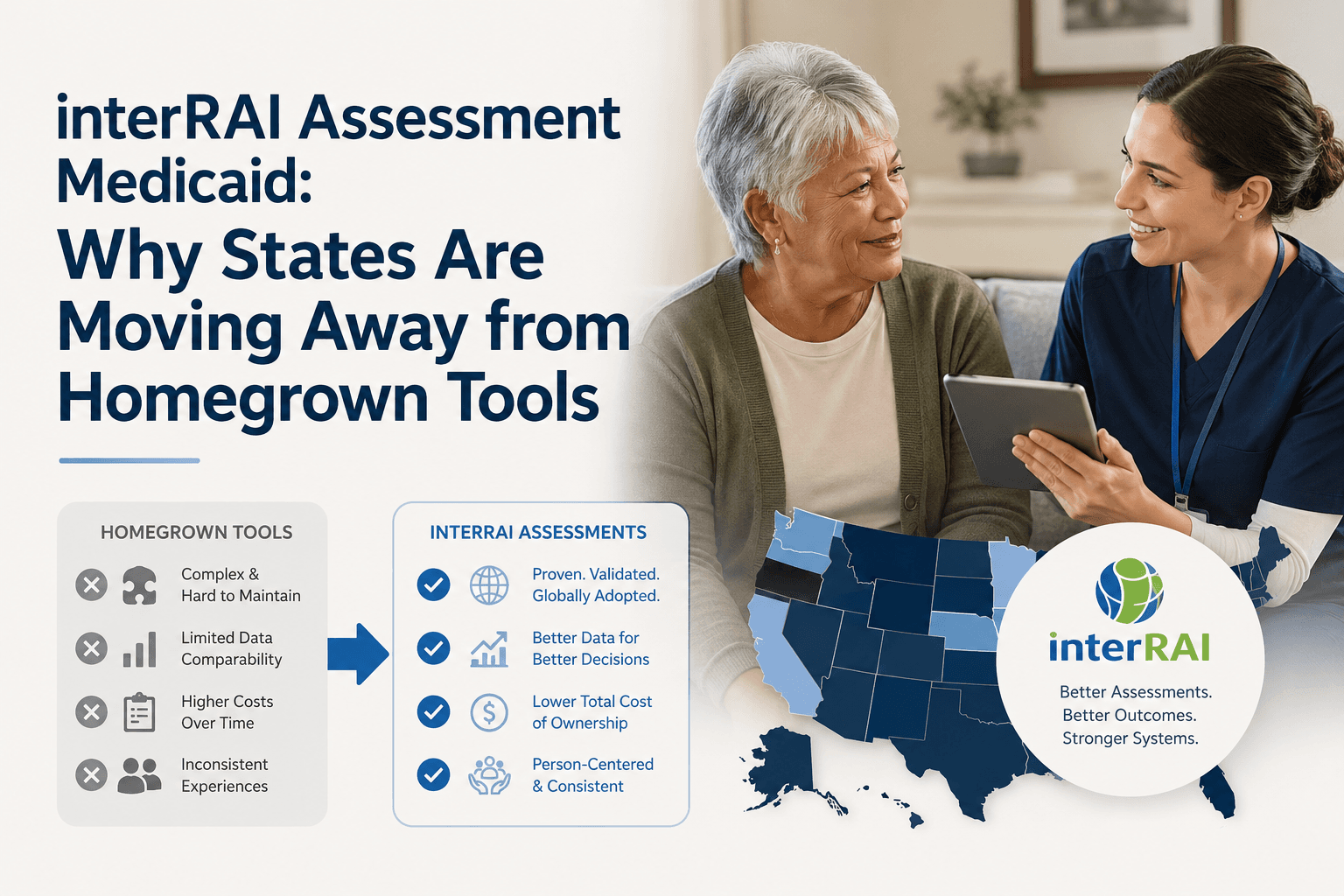
States are retiring homegrown assessment tools in favor of interRAI. Here is what is driving the shift and what it means for Medicaid compliance.
The interRAI assessment Medicaid connection has grown stronger over the past decade. As states face increasing pressure from CMS to demonstrate data quality, equitable eligibility determinations, and cross-program comparability, many are stepping back and asking a hard question: is our homegrown assessment instrument actually serving us well?
For states that built their own tools years ago, the answer is often uncomfortable. Homegrown instruments were frequently designed in isolation, reflect older clinical thinking, and produce data that is difficult to compare across programs or jurisdictions. interRAI, by contrast, is a validated, internationally recognized suite of assessment instruments that has become a benchmark for functional eligibility determination in long-term services and supports. This post breaks down the key differences and explains why standardization on interRAI is accelerating.
What Is interRAI and How Does It Fit Into Medicaid LTSS?
interRAI is a collaborative research network that has developed a family of standardized clinical assessment instruments used across care settings, including home and community-based services, nursing facilities, assisted living, and inpatient psychiatry. Each instrument in the suite shares a common set of core items, called the interRAI Common Clinical Assessment Language, which allows data collected in one setting to be compared meaningfully with data from another.
In the Medicaid LTSS context, interRAI instruments such as the interRAI Home Care, the interRAI Long-Term Care Facilities instrument, and the interRAI Community Health Assessment are used to determine functional eligibility, develop person-centered care plans, and monitor outcomes over time. CMS and the Administration for Community Living have both pointed to validated, standardized instruments as a best practice for states operating home and community-based services programs under Section 1915(c) waivers and Managed LTSS contracts.
The Appeal of Homegrown Tools, and Where They Fall Short
Many states built their own assessment instruments for understandable reasons. They wanted tools tailored to their specific eligibility criteria, their existing IT systems, and their political and administrative constraints. In the short term, a homegrown instrument can seem like a perfect fit.
Over time, however, several problems tend to emerge. First, homegrown tools are rarely validated against a clinical gold standard. Without validation, a state cannot be confident that the instrument is accurately measuring functional status or predicting care needs. Two assessors using the same instrument may score identical individuals very differently, which creates legal exposure and equity concerns.
Second, homegrown instruments make it nearly impossible to benchmark outcomes against other states or against national research. When CMS asks whether a state's HCBS population is experiencing improved quality of life or reduced avoidable hospitalizations, a state using a proprietary tool has limited ability to answer that question with credible data.
Third, the maintenance burden is significant. A state that owns its instrument must fund ongoing clinical review, item testing, and software updates entirely from its own budget. When federal requirements evolve, as they do regularly, the state must scramble to revise its instrument without the benefit of an established research community behind it.
Data Quality: A Core Driver of Standardization
Data quality is perhaps the most compelling argument for interRAI. The interRAI instruments have been subjected to extensive reliability and validity testing across multiple countries and care settings. Inter-rater reliability, meaning the degree to which two different assessors produce the same score for the same individual, is a documented strength of the interRAI suite when assessors are properly trained.
Homegrown tools rarely have this level of testing behind them. States that have conducted their own inter-rater reliability studies often find significant variation between assessors, which means that two people with identical needs may receive different levels of authorized services depending on who conducted the assessment. This is not just a data quality problem; it is a civil rights and program integrity problem.
Standardized data also supports fraud detection and quality oversight. When every assessment uses the same items and scoring logic, anomalies are easier to detect. Assessment entities, MCOs, and state oversight staff can identify patterns that might indicate gaming of the eligibility determination process.
Functional Eligibility: Getting the Level of Need Right
Functional eligibility determination is where assessment instrument design has the most direct consequence for individuals. A poorly designed instrument can systematically undercount or overcount need, either denying services to people who require them or authorizing levels of service that do not match clinical reality.
The interRAI instruments use embedded clinical algorithms, called Clinical Assessment Protocols or CAPs, that flag areas of clinical risk and need based on item-level responses. These protocols guide assessors and care planners toward relevant clinical concerns such as fall risk, cognitive decline, pain management, and caregiver stress. Homegrown tools rarely include anything equivalent, which means that important clinical signals can be missed.
From an eligibility standpoint, interRAI instruments produce Resource Utilization Group scores and other validated classification outputs that states can use as the basis for level-of-care determinations. These classifications have been studied and refined over many years, giving states a defensible, evidence-based foundation for their eligibility thresholds.
Comparability Across Programs and Populations
One of the most underappreciated advantages of interRAI is cross-program comparability. A state operating multiple HCBS waivers, a state plan personal care program, and a managed LTSS contract may be using different instruments for each program, making it impossible to understand the overall population or track individuals as they move between programs.
Because interRAI instruments share a common clinical language, a state that standardizes across programs can finally answer questions like: What happens to individuals who transition from a nursing facility to a home-based waiver? Are individuals with similar functional profiles receiving equitable services across different program populations? How do outcomes differ between managed care and fee-for-service LTSS enrollees?
CMS has signaled interest in this type of cross-program data as part of its broader quality measurement and value-based care agenda. States that cannot produce comparable data across their LTSS programs will be at a disadvantage as federal oversight and reporting requirements continue to evolve.
The Federal Policy Environment Is Reinforcing the Shift
Federal policy is moving in a direction that favors standardized, validated assessment instruments. CMS guidance on managed LTSS has consistently emphasized the importance of consistent, needs-based assessment as a foundation for person-centered service planning. The HCBS Settings Rule, Section 12006 of the Affordable Care Act, and various CMS informational bulletins have all reinforced the expectation that states operate LTSS programs based on objective, individualized assessment of need.
ACL has similarly emphasized the role of standardized assessment in its grant programs and technical assistance work, particularly as states work to build more integrated systems that connect Medicaid LTSS with aging services and disability programs. Homegrown tools make integration harder because their data cannot be mapped reliably to data from other systems.
States that have already migrated to interRAI often report that the transition strengthened their position in CMS waiver reviews and quality assurance discussions, because they can present data that is immediately recognizable and interpretable to federal reviewers.
Implementation Considerations: Training, Workflow, and Technology
Transitioning from a homegrown instrument to interRAI is not a trivial project. States need to invest in assessor training, because the reliability advantages of interRAI depend on assessors understanding and applying item definitions consistently. interRAI offers structured training resources, and many states have built train-the-trainer programs to scale initial certification across their assessor workforce.
Workflow redesign is also necessary. interRAI assessments are more comprehensive than many homegrown tools, which means assessment appointments may take longer, and the documentation process requires a platform that supports the instrument structure properly. States should also plan for a crosswalk period during which legacy data from the homegrown system needs to be mapped, as much as possible, to the new instrument to preserve continuity for longitudinal analysis.
Technology infrastructure matters significantly here. An assessment platform that natively supports the interRAI instrument structure, including CAPs, embedded scoring, and data export in standard formats, reduces the risk of implementation errors and speeds up the transition. CertifyMed's interRAI assessments capability is built specifically to support this workflow, giving state agencies and assessment entities a purpose-built environment for administering interRAI instruments, managing assessor assignments, and routing completed assessments into downstream care planning and eligibility determination processes.
What State Agencies and Assessment Entities Should Do Now
If your state is still operating a homegrown assessment instrument, the first step is an honest evaluation of its performance. Review your inter-rater reliability data if you have it. Examine whether your instrument produces data that can support the quality reporting CMS and your managed care partners are likely to require in the next contracting cycle. Consider whether your current tool would survive scrutiny in a federal waiver review or a fair hearing appeal.
If the evaluation reveals gaps, use that analysis to build the internal case for migration to interRAI. Engage your clinical leadership, your IT staff, and your managed care partners early. Identify a technology partner that has actual experience supporting interRAI implementations in a Medicaid context, not just a vendor who says the platform can accommodate any assessment format.
The states that are furthest ahead on LTSS data quality and program integrity are, almost universally, the ones that made the investment in standardized assessment infrastructure. interRAI is not a perfect tool, and implementation requires real resources. But the alternative, continuing to operate on a homegrown instrument that cannot be validated, compared, or scaled, is a risk that is becoming harder to justify as federal expectations rise and the populations states serve grow more complex.
CertifyMed Blog
Clinical & Assessments
Translating assessment science into practical guidance for HCBS providers.
Walk into your next survey ready.
See how state agencies, MCOs, and provider networks run assessment, care planning, and continuous compliance on one platform.