
HCBS Workforce Compliance: Credentialing, Training Records, and Audit Readiness for Direct-Care Staff
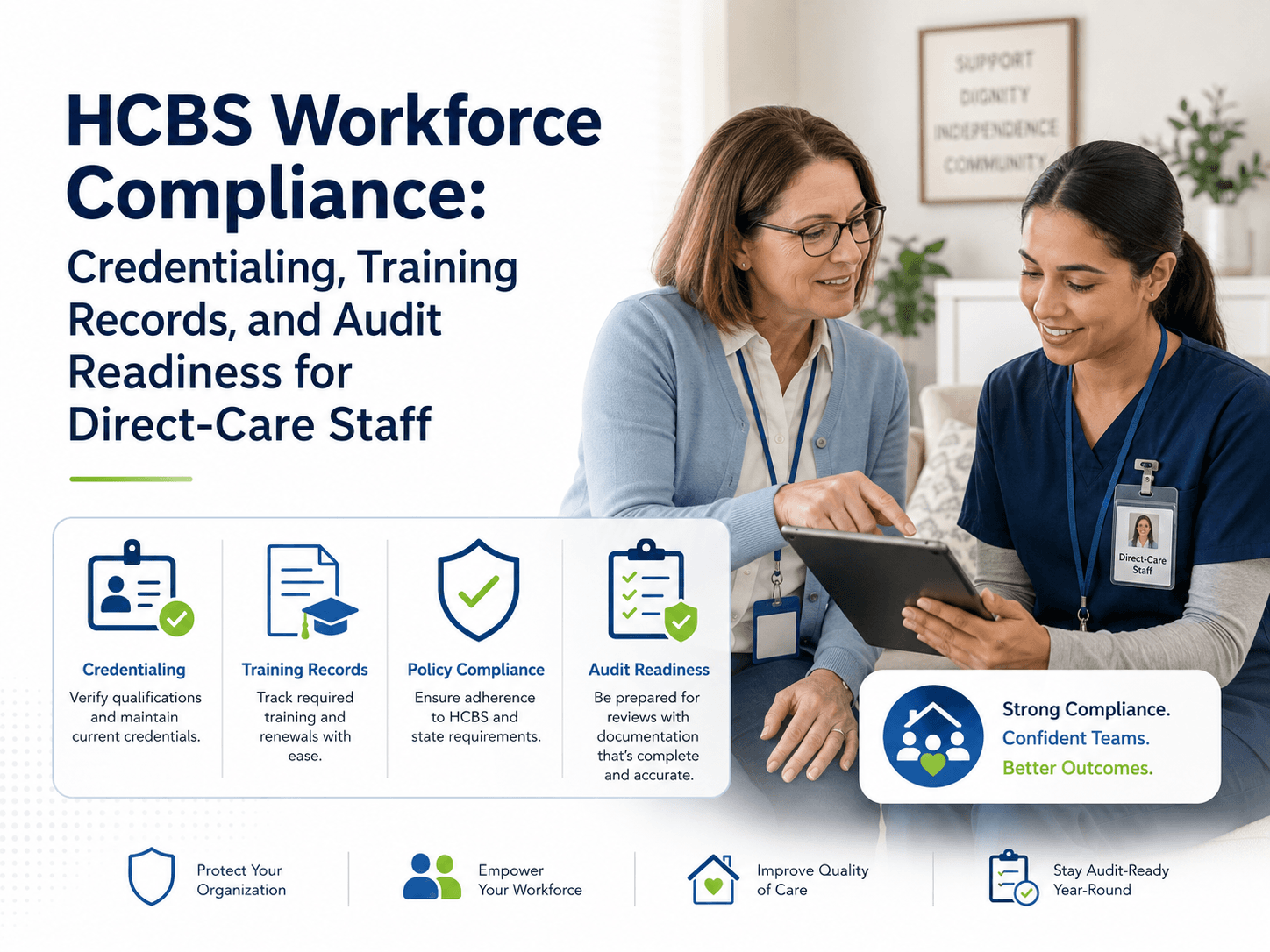
Direct-care workforce compliance for HCBS providers covers credentialing, training documentation, the 80/20 rule, and audit readiness.
HCBS workforce compliance is one of the most operationally demanding areas for any provider organization, MCO, or state Medicaid agency overseeing home and community-based services. The direct-care workforce, including personal care aides, home health aides, and community support workers, sits at the center of service delivery and at the center of regulatory scrutiny.
Gaps in credentialing, expired training records, or misapplied compensation rules can trigger deficiency findings, payment recoupments, or loss of Medicaid provider status. This post breaks down the core compliance obligations that HCBS organizations need to manage on an ongoing basis and explains how purpose-built workforce compliance tools can reduce risk.
Why the Direct-Care Workforce Is a Compliance Priority
CMS and state Medicaid agencies have placed increasing regulatory attention on direct-care workers in recent years. The final HCBS Settings Rule, Medicaid managed care access and quality standards, and the broader HCBS Strengthening proposed rule framework all reflect a policy direction that ties payment adequacy and provider accountability directly to frontline staffing quality.
For surveyors and auditors, direct-care staff records are a practical starting point. Credential verification, background check documentation, training completion logs, and competency assessments are tangible records that an auditor can pull and review in a limited time window. Organizations that treat workforce documentation as an afterthought typically discover the gap during an audit rather than before it.
Credentialing Requirements for HCBS Direct-Care Workers
Credentialing in the HCBS context does not always mean a formal licensure process, but it does mean verifying that each worker meets the qualifications required by state Medicaid rules, service definitions, and any applicable waiver or managed care contract. Requirements vary by service type and state, but common credentialing elements include background checks through state and federal registries, verification of required training or certification for the specific service (such as personal care or respite), and exclusion screening against the OIG List of Excluded Individuals and Entities and the System for Award Management.
Exclusion screening deserves particular attention. CMS guidance and the OIG Compliance Program Guidance make clear that Medicaid payments cannot flow to providers who employ or contract with excluded individuals. Screening at hire is necessary, but screening must also occur on a recurring basis, typically monthly. A single gap in recurring exclusion screening for a direct-care worker who later appears on the exclusion list can create retroactive payment liability for every claim submitted during that period.
State-specific registries, such as nurse aide registries, personal care worker registries, or abuse and neglect registries, add another layer of required verification. Organizations operating in multiple states must track each state's specific registry requirements and renewal cycles.
Training and Competency Documentation
Medicaid HCBS rules generally require that direct-care workers complete specific training before providing services independently and that they receive ongoing training at defined intervals. The exact curriculum, hours, and competency evaluation methods are set at the state level, often with additional requirements layered in by managed care contracts or specific waiver service definitions.
From a compliance standpoint, the training record is as important as the training itself. An auditor reviewing a worker's file will look for dated completion records, trainer credentials where required, competency evaluation results, and documentation that training was specific to the services the worker is authorized to provide. Generic training certificates that do not map to the service type or that predate the worker's hire are common findings.
Organizations that rely on spreadsheets or disconnected learning management systems often struggle to produce a complete, organized training record on demand. CertifyMed's workforce compliance module is designed to centralize training records, automate expiration alerts, and generate worker-level documentation packages that map directly to what an auditor will request.
The 80/20 Direct-Care Compensation Provision
One of the most significant financial compliance requirements for HCBS providers in recent years stems from the Medicaid HCBS access final rule, which includes a provision requiring that a defined percentage of Medicaid payments for certain personal care and similar services be spent on direct-care worker compensation. This requirement is commonly referred to as the 80/20 provision or pass-through requirement, reflecting the policy goal that the majority of Medicaid dollars for hands-on services reach the workers who deliver those services.
The specific percentage threshold and the services covered under this requirement are established in CMS rulemaking and implemented by states over a phase-in period. Providers subject to this requirement must be able to demonstrate through financial records that their compensation expenditures for direct-care workers meet the required threshold relative to Medicaid revenue received for covered services.
Compliance with the 80/20 provision requires coordination between finance, HR, and compliance functions. Organizations need a clear definition of which worker classifications qualify as direct-care for purposes of the calculation, a methodology for allocating compensation costs to covered services, and a documentation structure that can withstand state or federal audit review. Providers who have not yet built this reporting infrastructure should treat it as an urgent priority given phase-in timelines.
Background Check Program Requirements
Federal law, specifically the National Background Check Program authorized under the Affordable Care Act, established a framework encouraging states to develop comprehensive background check programs for direct-care workers in long-term care settings, including HCBS. Many states have now enacted their own statutory requirements tied to this framework, and Medicaid managed care contracts frequently incorporate background check standards as a condition of participation.
A compliant background check program for HCBS workers generally covers criminal history checks at the state and sometimes federal level, sex offender registry searches, and adult abuse and neglect registry checks. Some states require checks in every state where the worker has resided over a defined lookback period. The compliance obligation does not end at hire. Many state programs require renewed checks at defined intervals, and any lapse in documentation creates audit exposure.
Organizations should also maintain clear policies on how they handle background check results, including the individualized assessment process required under the Equal Employment Opportunity Commission guidance when a criminal history finding is present. The policy and any individualized assessment records should be retained as part of the worker compliance file.
Keeping Workforce Documentation Audit-Ready
Audit readiness for workforce documentation is not a one-time project. It is an ongoing operational discipline. The core elements of an audit-ready workforce compliance program include a complete, organized file for each active worker covering credentialing, background checks, exclusion screening history, training records, and competency evaluations; a system for tracking expiration dates and triggering renewal actions before a lapse occurs; and a process for removing or suspending workers from service delivery when a compliance issue is identified pending resolution.
Surveyors and managed care auditors frequently request worker files on short notice, sometimes asking for a sample of files within hours of arriving on site or initiating a desk review. Organizations that cannot produce complete, organized files quickly are at a disadvantage regardless of whether the underlying records actually exist somewhere in the system.
CertifyMed's workforce compliance capability is built around this operational reality. The platform maintains a centralized compliance status view for each worker, flags expiring credentials and training requirements in advance, and supports rapid file production for audit response. Organizations that have implemented the platform report meaningful reductions in the time required to respond to audit document requests.
Connecting Workforce Compliance to Case Management and Member Outcomes
Workforce compliance does not exist in isolation from the broader HCBS compliance picture. The quality and continuity of direct-care staffing has a direct relationship to member outcomes, care plan implementation, and the person-centered service requirements embedded in HCBS policy.
When a worker's credentials lapse or a training gap goes unresolved, the ripple effect extends beyond the compliance file. Service delivery may be disrupted, care plans may not be implemented as written, and members may experience gaps in support. Connecting workforce compliance data to case management functions creates visibility into these risks before they affect members.
CertifyMed's integrated platform links workforce compliance status to case management workflows, giving care coordinators and compliance staff a shared view of which workers are active, credentialed, and trained for the specific services on a member's plan. This integration supports the kind of proactive risk management that auditors and accreditation reviewers increasingly expect from mature HCBS programs.
Building a Sustainable Workforce Compliance Program
The direct-care workforce in HCBS operates at high turnover rates in most markets, which means credentialing and training onboarding processes run continuously rather than as periodic events. A sustainable workforce compliance program builds compliance verification into every stage of the worker lifecycle, from pre-hire screening through ongoing monitoring and offboarding.
Leadership commitment matters as much as the technology infrastructure. Organizations where compliance is treated as a shared responsibility across HR, operations, and clinical or program management teams consistently outperform those where compliance is siloed in a single department. Regular internal audits of workforce files, calibrated against the documentation standards that external auditors apply, are a practical way to identify gaps before they become findings.
HCBS workforce compliance is not a static target. CMS rulemaking, state Medicaid plan amendments, and managed care contract updates regularly introduce new requirements or modify existing ones. Organizations that invest in scalable compliance infrastructure and stay current with regulatory developments will be better positioned to absorb those changes without operational disruption.
CertifyMed Blog
Clinical & Assessments
Translating assessment science into practical guidance for HCBS providers.
Walk into your next survey ready.
See how state agencies, MCOs, and provider networks run assessment, care planning, and continuous compliance on one platform.