
HCBS Survey Readiness: How Providers Can Stay Audit-Ready Every Day
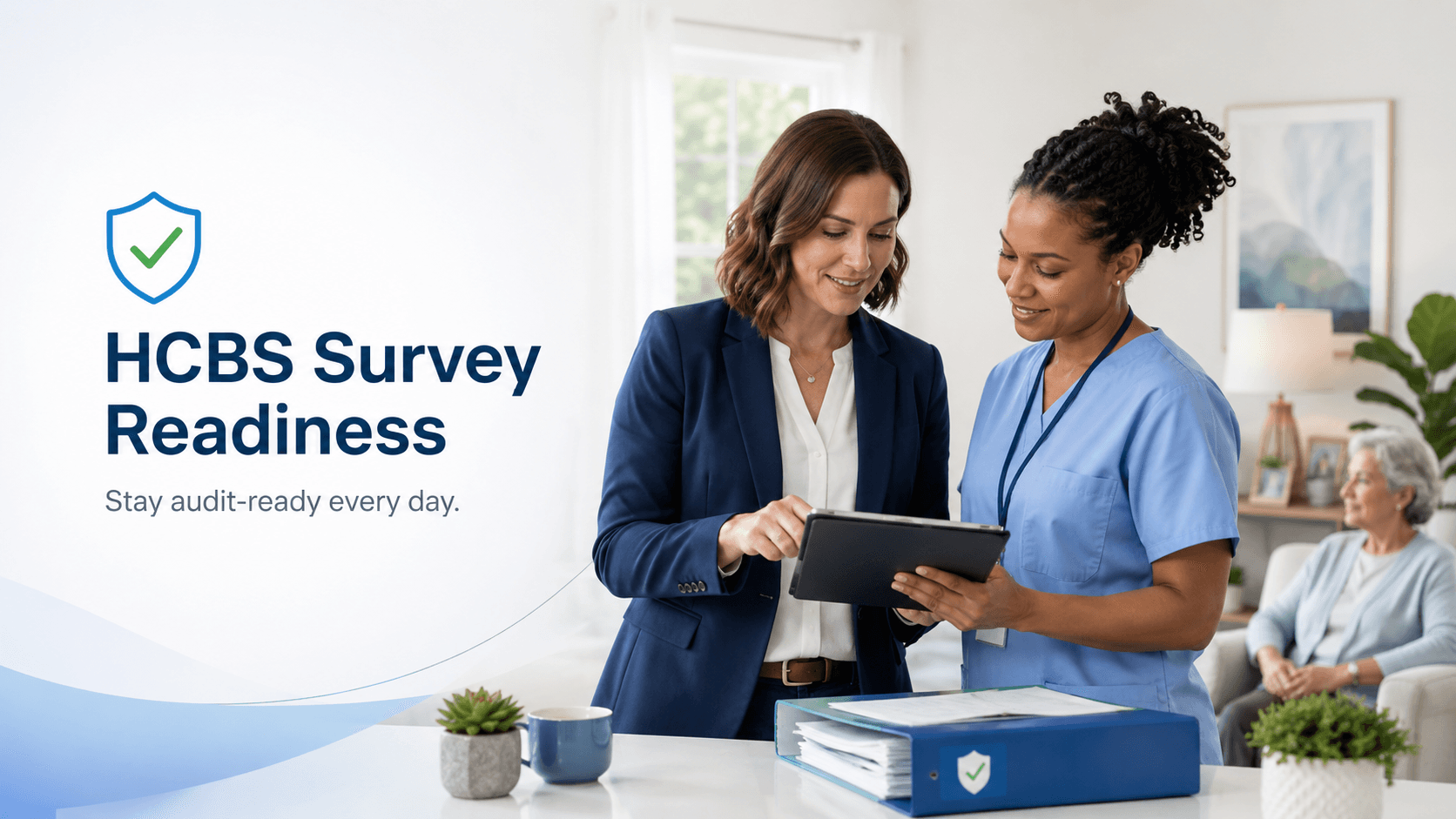
Stop scrambling before surveys. Learn how HCBS providers build continuous audit readiness through evidence-based compliance and ongoing monitoring.
HCBS survey readiness should not be a six-week fire drill. For providers operating under state Medicaid waiver programs and federal HCBS settings requirements, a survey can arrive with limited notice, and the organizations that fare best are the ones that treat compliance as a daily operating standard rather than a seasonal project.
This post walks through the core elements of a continuous readiness posture, the findings surveyors most commonly document, and how the right compliance infrastructure keeps your organization prepared on any given day of the year.
Why 'Survey Season' Thinking Creates Risk
Many HCBS provider organizations still operate on a reactive compliance model: gather documents, update policies, and coach staff in the weeks before a scheduled survey or revalidation review. The problem is that Medicaid managed care organizations, state oversight agencies, and CMS itself have broadened their monitoring activities considerably in recent years. Desk reviews, encounter data audits, incident report follow-ups, and unannounced site visits can all trigger scrutiny outside of a formal survey cycle.
When compliance is treated as periodic, gaps accumulate between review cycles. A person-centered service plan that was compliant at approval may drift as a participant's needs change. A direct support professional hired twelve months ago may have a credential that has since lapsed. These issues go undetected until a surveyor walks in, at which point the documentation gap is a finding rather than a correction.
Providers that sustain a continuous readiness posture catch these issues themselves, document corrective action, and present a far stronger compliance record to any reviewer.
The Federal Foundation: What HCBS Rules Actually Require
The CMS HCBS Settings Rule established that waiver services must be delivered in settings that are integrated in and support access to the greater community. Compliance is not a one-time attestation. States are required to demonstrate ongoing compliance, which means they expect providers to demonstrate it as well through documentation, policies, and observable practice.
On top of settings requirements, providers must meet the person-centered planning standards embedded in federal regulations and in state waiver assurances. Those standards govern how plans are developed, who participates, how participant choice is documented, and how plans are updated when circumstances change. Surveyors reviewing HCBS programs commonly examine whether plans reflect genuine participant voice or whether they read as provider-generated documents with a signature at the bottom.
Federal quality assurance and improvement requirements, which flow through state waiver applications, also require providers to participate in incident reporting, critical incident management, and remediation. Each of these creates a documentation trail that surveyors will review.
Common Survey Findings HCBS Providers Should Anticipate
Based on patterns visible across state oversight activity and CMS technical assistance materials, the following areas generate a disproportionate share of survey findings for HCBS providers.
Person-centered plan deficiencies: Plans that lack specificity about participant preferences, that were not updated following a change in condition or goals, or that do not document informed choice of setting and provider.
Workforce documentation gaps: Missing, expired, or incomplete background check records, training completion records, and competency validations for direct support staff. Because HCBS workforce turnover is high, this category is a persistent vulnerability.
Incident reporting failures: Incidents not reported within required timeframes, incident reports that are incomplete, or patterns of incidents that were never escalated to a quality review process.
Settings compliance evidence: Insufficient documentation that settings meet integration and non-disability-specific standards, including evidence that participants can come and go freely, have privacy in their living spaces, and are not subject to coercive practices.
Supervision and delegation records: In states with nurse delegation or supervisory visit requirements, missing documentation of those visits and any corrective guidance provided.
Building a Continuous Compliance Framework
Continuous readiness is not about doing more paperwork. It is about structuring your existing compliance activities so that evidence accumulates automatically and is retrievable when needed.
Start with a compliance calendar that maps every recurring obligation: plan review cycles, background check renewal windows, training due dates, supervisory visit schedules, and incident report deadlines. This calendar should not live in a spreadsheet that one compliance manager maintains. It should be embedded in the workflows that operational staff use every day.
Next, define the documentation standard for each obligation. What does a complete, compliant person-centered plan look like in your organization? What evidence proves that a setting meets HCBS standards? Write these standards down and build internal audit tools around them. Surveyors apply defined standards; your internal audits should apply the same ones.
Finally, assign ownership. Every compliance obligation should have a named responsible party, a due date, and an escalation path when it falls behind. Ambiguity about ownership is one of the most common reasons that known compliance gaps go unresolved until survey time.
The Role of Ongoing Monitoring and Internal Audits
Policies and calendars define what should happen. Ongoing monitoring confirms whether it actually is. For HCBS providers, an internal monitoring program should cover at minimum a regular sample of case files, workforce credential records, and incident documentation.
Case file audits should check whether person-centered plans are current, whether service delivery records match the authorized service plan, and whether documented participant preferences are actually reflected in how services are delivered. A plan that says the participant prefers morning personal care but consistently shows afternoon service delivery without explanation is a compliance signal.
Workforce monitoring should generate a real-time view of credential status. Because background check expiration windows, CPR certification renewal cycles, and state-specific training requirements all operate on different timelines, manual tracking is error-prone at scale. Providers with larger workforces should use automated tracking that flags expirations before they occur rather than after.
Incident monitoring should look at both individual incidents and patterns. A single incident that was reported on time and handled correctly is a compliance positive. A cluster of incidents involving the same participant, the same staff member, or the same setting that was never escalated to a quality review is a pattern finding waiting to happen.
How Technology Supports Always-On Readiness
A compliance dashboard purpose-built for HCBS programs centralizes monitoring activity and surfaces issues before they become findings. Rather than running manual audits across disconnected systems, compliance staff can work from a single view that aggregates status across care planning, workforce credentials, incident reporting, and service delivery.
CertifyMed's compliance dashboard is designed specifically for this operating model. It provides configurable alerts for upcoming credential expirations, overdue plan reviews, and open incident reports that have not been resolved within defined timeframes. Compliance officers can see their organization's posture across all participants and staff at a glance, drill into specific issues, and document corrective actions directly in the platform.
Connecting your compliance dashboard to your case management and workforce compliance tools closes the gap between data entry and oversight. When a service plan is updated, the compliance record updates. When a staff credential is renewed, the expiration alert clears. The evidence that a surveyor would want to see is generated as a natural byproduct of day-to-day operations rather than assembled under deadline pressure.
Preparing Your Team for the Survey Itself
Even with strong documentation practices, surveys involve people. Staff who are unprepared to speak with surveyors, or who give inconsistent answers about how person-centered planning actually works in practice, can create impressions that documentation alone cannot fully correct.
Build a standing survey readiness orientation into your onboarding and annual training programs. Staff at all levels should understand what surveyors are looking for, how to describe their role in supporting participant choice, and what to do if they are uncertain about a question. They should also know who the designated survey coordinator is and how to route surveyor questions appropriately.
Practice walkthroughs are a useful tool. Periodically assign a staff member or internal auditor to conduct a mock survey using the same tools a state surveyor would apply. Document findings, assign corrections, and track remediation. Organizations that do this consistently are rarely surprised by what an external surveyor finds.
Making the Case for Continuous Readiness Investment
Leadership buy-in for compliance infrastructure investment sometimes requires a business case framing. Consider the direct costs of a survey that results in a corrective action plan: staff time to prepare the response, potential service authorization holds while deficiencies are resolved, and the reputational impact with MCO partners or state oversight agencies.
Against that, the ongoing investment in a compliance platform and internal monitoring program is modest by comparison. More importantly, continuous readiness programs tend to surface process improvements that also drive better participant outcomes, which matters for value-based contracting arrangements that more state Medicaid programs are adopting.
HCBS survey readiness is not a compliance team problem. It is an organizational strategy. Providers that treat it that way build durable programs, stronger surveyor relationships, and more consistent quality outcomes for the people they serve. If your organization is evaluating how to close the gap between where your compliance posture is today and where it needs to be, CertifyMed's compliance dashboard is a practical starting point for that conversation.
CertifyMed Blog
Clinical & Assessments
Translating assessment science into practical guidance for HCBS providers.
Walk into your next survey ready.
See how state agencies, MCOs, and provider networks run assessment, care planning, and continuous compliance on one platform.